
Peptides
Last Updated
Jun 10, 2026
Table of contents
My interest in hormonal optimization did not start with a crisis. It started with a slow decline in energy, focus, and drive. I suspected testosterone was part of the picture, and while TRT is the obvious path, my research kept pulling me toward something more targeted: peptides that work with the body’s own production system instead of overriding it.
This is the result of that investigation, written for the data-minded reader who wants mechanism and clinical context, not hype. There is no single best peptide for testosterone. There is a spectrum of signaling molecules, each acting at a different level of the hypothalamic-pituitary-gonadal (HPG) axis, the command center for hormone production. Understand where each one acts, and the right choice for your situation becomes obvious. That is what the map below is for.
The map
Where each peptide acts on the axis.
Testosterone production runs top-down through the HPG axis. Each peptide plugs in at a different level, and that single fact explains its use case, its power, and its risks.
Fires GnRH in rhythmic pulses every 90 to 120 minutes. This is the genesis of the whole cascade.
The pulse tells the pituitary to act. Replicate the rhythm and you reboot the system. Flood it continuously and you shut it down.
Responds to the GnRH pulse by secreting Luteinizing Hormone (LH) and Follicle-Stimulating Hormone (FSH).
Travel through the blood to the testes. LH is the direct on-switch for testosterone synthesis.
Receive the LH signal and produce testosterone, while also maintaining sperm production and testicular volume.
The end product the entire axis exists to make.
PT-141 works outside the axis entirely. It acts on arousal pathways in the brain, supporting the libido and sexual function that keep the system reinforced, rather than producing testosterone directly.
Side by side
The five, compared.
| Peptide | Acts on | Mechanism | Best for | Status |
|---|---|---|---|---|
Gonadorelin GnRH analogue |
Hypothalamus to pituitary signal | Pulsed dosing reboots the entire axis from the top down | Secondary hypogonadism, restoring natural production and fertility | Prescription |
HCG LH mimetic |
Testes (Leydig cells) | Mimics LH, directly stimulating testosterone production | Preventing testicular atrophy and preserving fertility on TRT | Prescription |
Kisspeptin Kiss1 |
Above GnRH (the GnRH neurons) | Master switch that triggers GnRH release; deepest upstream point | Diagnosis and investigational treatment of central hypogonadism | Investigational |
LHRH agonists Leuprolide, triptorelin |
Pituitary GnRH receptors | Brief testosterone flare, then desensitizes and shuts the axis down | Specialist procedural use only, not ongoing optimization | Specialist |
PT-141 Bremelanotide |
Brain melanocortin receptors | Central arousal pathway, supports libido rather than testosterone directly | Low libido or sexual dysfunction, often alongside TRT | Prescription |
Match to goal
Which one for which goal.
The honest answer to "what is the best peptide for testosterone" depends entirely on what you are solving for.
In depth
The five peptides, explained.
GnRH (Gonadorelin)
GnRH is the master regulator and the very first domino. Produced in the hypothalamus, it signals the pituitary to release LH and FSH, which in turn drive the testes to make testosterone. The critical detail is its pulsatile nature: the body releases it in bursts every 90 to 120 minutes, and a continuous stream paradoxically shuts production down. Therapeutic use with a synthetic analogue like gonadorelin therefore aims to replicate that rhythm, often through a micro-infusion pump, restoring the entire axis from the top rather than replacing the final hormone the way TRT does.
Ideal candidate
- Men with secondary hypogonadism, specifically isolated hypogonadotropic hypogonadism (healthy testes, missing brain signal)
- Anyone prioritizing fertility and testicular function alongside testosterone
How it compares
- Unlike TRT, it kickstarts production instead of suppressing it
- Works further upstream than HCG, restoring the whole axis rather than just the testes
HCG (Human Chorionic Gonadotropin)
HCG goes straight to the factory floor. It mimics LH, binding the receptors on the Leydig cells in the testes and commanding them to produce testosterone and hold their volume. By bypassing the brain and pituitary entirely, it delivers a reliable, predictable boost in the body’s own production, which is exactly why it is a staple for preventing the testicular shutdown that standalone TRT tends to cause.
Ideal candidate
- Men on TRT who want to prevent testicular atrophy and preserve fertility
- Fertility-clinic patients restarting production before assisted reproduction
How it compares
- More direct than GnRH, but does not restore the brain-level signaling
- Effects appear fast, often within 2 to 4 weeks
Kisspeptin (Kiss1)
Kisspeptin sits one level above GnRH, acting as the conductor that cues the first domino. Produced in the hypothalamus, it directly activates the GnRH-producing neurons, triggering the cascade that ends in testosterone. Administering it produces a robust, immediate rise in GnRH, LH, FSH, and testosterone, which also makes it a uniquely powerful diagnostic for confirming whether the entire axis is functional from the brain down.
Ideal candidate
- Complex or central hypogonadism, in research and advanced diagnostic settings
- Investigational use for low libido, where it has shown effects independent of testosterone
How it compares
- Even more upstream than GnRH, addressing the neural control of the system
- Still largely investigational; long-term safety and efficacy are not yet established
LHRH Agonists (Leuprolide, Triptorelin, Goserelin)
These synthetic peptides offer only a brief, paradoxical window for raising testosterone. Structurally similar to GnRH, they first overstimulate the pituitary receptors, producing a 7 to 14 day surge in LH, FSH, and testosterone. Then the continuous signal desensitizes those receptors, shuts the axis down, and drops testosterone to castrate levels. Their primary clinical use is actually to suppress testosterone, so harnessing the initial flare is a narrow, specialized application.
Ideal candidate
- Specific reproductive-medicine procedures, such as triggering oocyte maturation in IVF
- Testing pituitary reserve under a specialist protocol
How it compares
- Opposite of pulsatile GnRH: one spike, then shutdown
- Unsuitable for ongoing testosterone optimization by design
PT-141 (Bremelanotide)
PT-141 takes an indirect route. Rather than stimulating hormone production, it binds melanocortin receptors in the hypothalamus to enhance arousal and sexual function, initiating desire from the brain rather than through the vascular pathway that drugs like Viagra use. Its link to testosterone is the well-documented loop between libido, sexual activity, and hormonal health: by restoring that fundamental part of male function, it helps create an environment where natural production thrives.
Ideal candidate
- Men with low libido or psychological ED, even when testosterone is in range
- An adjunct to TRT when raised testosterone has not translated to desire
How it compares
- Works on demand and from the brain, effective when ED medications fail
- Supportive rather than a direct testosterone driver
The path forward
From information to action.
Mechanism matters most
How a peptide works decides whether it fits you and how it must be monitored. A direct LH mimic like HCG and an upstream activator like kisspeptin are not interchangeable.
Data is your compass
You cannot manage what you do not measure. A full baseline panel is non-negotiable, and ongoing testing is the feedback loop that lets you adjust safely.
Expert supervision is mandatory
This is not a do-it-yourself endeavor. The potential to disrupt your entire endocrine system is real. A qualified clinician interprets your labs, designs a safe protocol, and manages side effects.
The question quietly upgrades itself. Not "what is the best peptide for testosterone," but "what is the best data-informed, medically supervised strategy for my specific biology." That shift, from chasing a magic bullet to building a system, is the whole game.
The data-driven version
OneTwenty builds the system, not the guesswork.
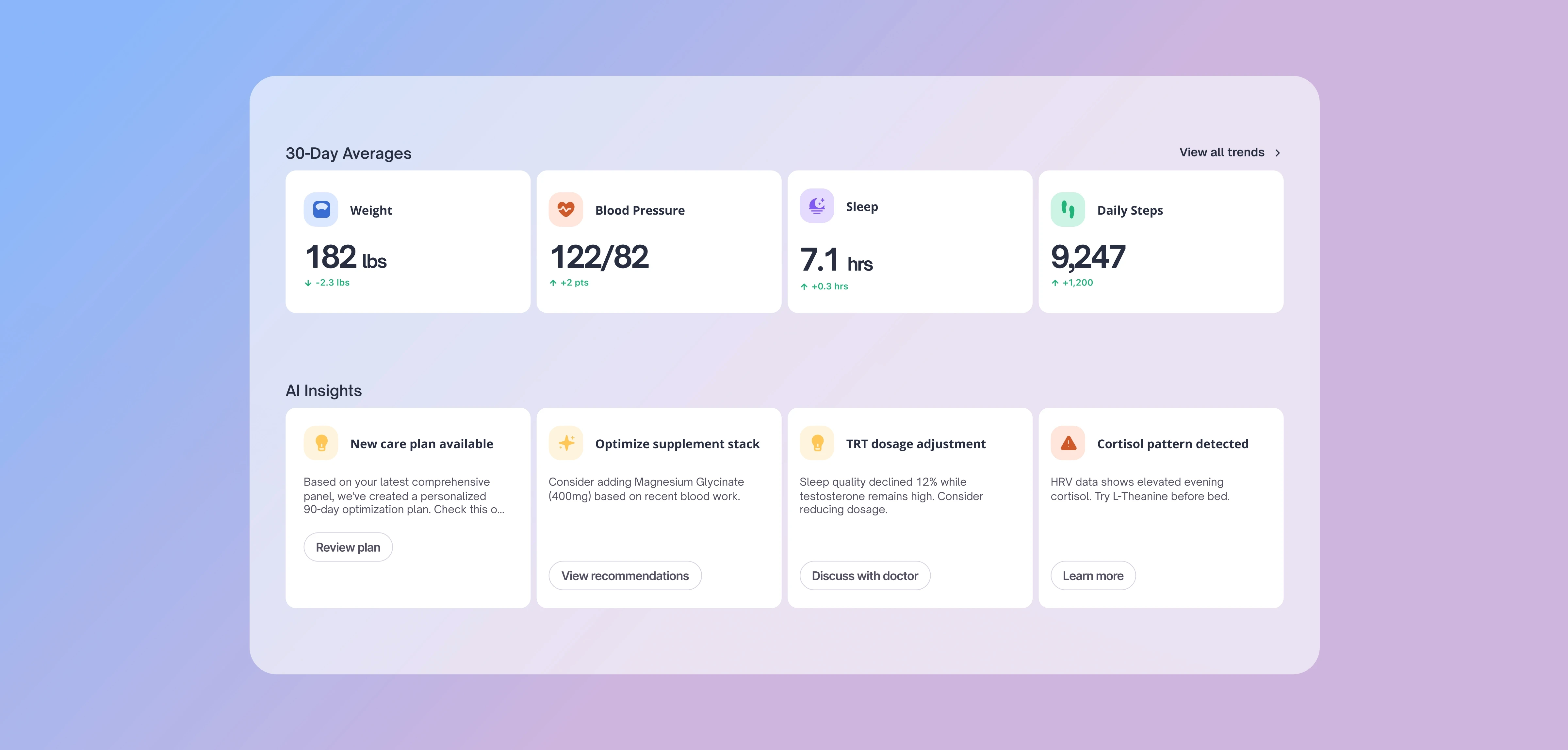
Navigating this well takes a partner built around data. OneTwenty pairs comprehensive lab testing (Total T, Free T, SHBG, LH, FSH, Estradiol, and more) with continuous wearable data and clinician-supervised protocols spanning TRT and the prescribable peptides covered here, including gonadorelin and PT-141. OneTwenty launches in June 2026 with medications.
Join the betaQuarterly panels · wearable integration · clinician-supervised · $499/yr
This article is educational and is not medical advice. Peptide and hormone therapies can disrupt the endocrine system and must be started and monitored by a licensed clinician using baseline and ongoing bloodwork. Availability and legal status of specific compounds vary and change over time.
Lifelong Optimization
Not your average
Checkup
Every life stage brings new biological demands. Tracking the right metrics at the right time helps you adapt, optimize performance, and extend both lifespan and healthspan.
Traditional
Manual Data Processing
Guesswork Trend Detection
Slow Campaign Setup
Multiple Tools, Multiple Logins
Reactive Decision-Making
Manual Reporting
Delayed Results
High Error Risk
Automated Data Sync
Real-Time Trend Insights
Instant AI Optimization
All-in-One Platform
Proactive AI-Driven Strategies
Auto-Generated Reports
Instant Performance Updates
AI Precision

Frequently Asked Questions
Clarity before
you commit
Answers on setup, scale, and support to remove blockers.